Wednesday, September 7, 2011

THE DAY AFTER GAME DAY

Contributed by: Dave

After the insanity that unfolded at Sierra Leone’s 2-1 victory over Egypt yesterday, we wisely planned a bit of a quiet day today. Kei Kamara had spent much of his interview talking about the importance of football in Sierra Leone, and though we had certainly witnessed this for ourselves, we felt we needed to capture the average person’s passion with our cameras.

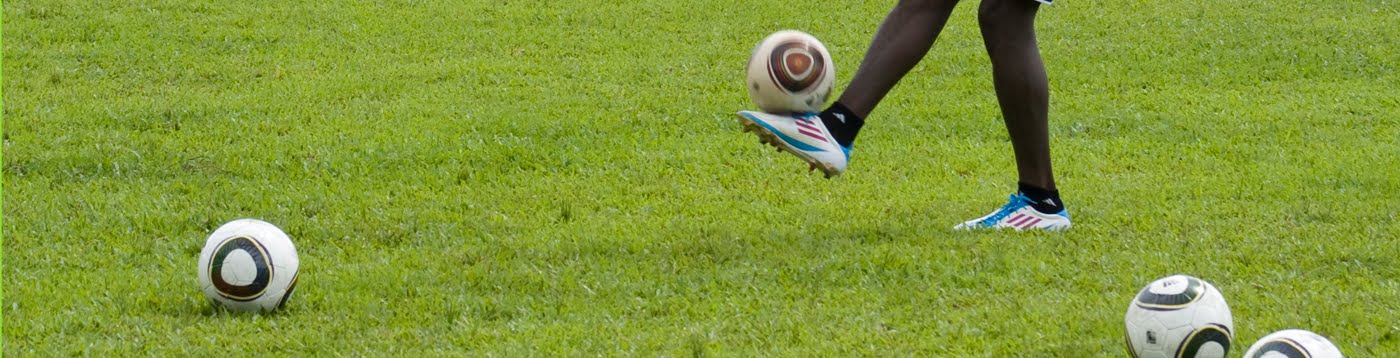
Right across the street from our hotel, games covered Lumley Beach. Picture your local beach on Fourth of July with blankets and umbrellas covering every available inch of sand. Replace those blankets and umbrellas with balls and makeshift goals and you’ll have an idea of what it was like.

Kei would later tell us that on Sunday, Lumley is the place to play. Guys would run from Kissy, miles away on the opposite side of the city, just to get there to play until they ran out of light. Even the national team gets in on the action. Over their winter holidays, the team arranges games along Lumley. Like the kids that dream of representing Salone, the Leone Stars head to the beach to work on their skills. If the tide is in too far, they sit in the sand, catching up until the water recedes and the game is on.

Unfortunately for us, the tide came in and we were sent searching for another match. We settled on a red clay pitch bordering Man of War Bay. When we arrived, no one was there. We decided to shoot it anyway—it was too picturesque to pass up. We were quickly met by curious children. They poked around our cameras a bit, then disappeared into high grass along the shore. Moments later, they materialized, carrying a small ball. The game began. It was still going a half hour later when the rains rolled in and sent us scattering to get our equipment safe.

And the rain. Oh, the rain. We plowed through Freetown as water flooded through the streets. To our driver, it was nothing. It was a way of life.

A catchall phrase around these parts is “This is Africa.” It’s meant to explain away things like late or missing vans, shady government officials and the general maddening frustration foreigners feel at this way of life. We’ve never been too fond of that sentiment. Because to us, this—the welcoming kids, the sandlot feel of games along Lumley, the resilience and adaptability of the people in face of inescapable challenges like the rainy season downpours—is Africa.

Monday, September 5, 2011

GAME DAY, PART 6: GAME ON

Contributed by: Dave

After a coach finally booted Chad from the field, he and I rendezvoused on the sideline and began looking for Clay and Josh. Unfortunately, when we met, just before the anthem, Clay and Josh were with a representative from the channel broadcasting the game. Though we’d cleared our shoot through every Sierra Leonean organization possible, the Confederation of African Football (CAF) owned the rights. We wouldn’t be able to shoot the rest of the game.

We were, however, invited to stand on the sidelines and watch the game. And what a game it turned out to be.

We’d never heard an anthem like this. There was a band to accompany the crowd, but it was quickly drowned out. Full-throated, earth-shaking, passion-filled fans belted out every word. It must have been heard throughout Freetown.

When you hear Kei talk about the treatment of the team or see how the conditions they are supposed to play in lack the basic necessities of a high school team, it’s hard to believe that he willingly turned down a chance to play for Bob Bradley and the United States Olympic team years ago. Kei knew the conditions he would be asked to play under if he played for Sierra Leone. But still, he chose green, not red, to go with his white and blue.

Why? That anthem stood for everything: the president’s speech to the team moments before gametime, the masses outside whose exuberance seemed to at times threaten the team’s safety, the flag in every home on gameday. He is a part of that. He may have spent his adult life in America, but it’s clear what this game, this team, this country, mean to him.

The Leone Stars would go on to capture a 2-1 victory and move to second in their group for AfCon qualifying. For us, the result may have been irrelevant—the experience is one we never thought we’d have and one that will never be duplicated—but for the people of this country, it clearly means so much more. Maybe our sports back home are too packaged and presented too neatly. We’re told who to root for and why. We’re given canned reasons to believe someone is an underdog and read storylines meant to prompt a reaction. That’s probably what we’re doing now. But when Kei tells you that he thinks that the Leone Stars can be the next Ivory Coast, and you can see he really means it, then you see what winning a qualifying match means to a country in need of hope and a little bit of celebration, you can’t help but want to see the green, white and blue flying over Brazil in 2014.

GAME DAY, PART 5: CHAD EARNS HIS FIRST CAP

Contributed by: Dave

Originally, we had been told we could go into the locker room with the team to film Kei getting ready. But since we had fallen so far behind the bus in the chaos, the federation thought that we might be disruptive. Instead of filming their final preparations, we were guided out to a space under the stadium where the Leone Stars would enter before making their way down the tunnel to the pitch.

Energy coursed through the building. Above us, the stands shook. Even from where we were, we could see that fans were crammed into every space available. It was hard to believe it was the same place we had spent the last several days.

Chad hadn’t planned on using the elaborate steadicam system that we had huffed to the stadium (quick note for the non-techies out there: the steadicam allows the user to run alongside action while keeping the motion silky smooth, but it also requires a vest that looks like a flak jacket and a swing arm that makes its wearer look a bit like a three-armed cop from the future). When he saw opportunity, though, he took it. He began ripping stuff out of our bag and assembling the equipment faster than I’ve ever seen him do it. He finished with no time to spare—no sooner had he stood up than the door to the locker room swung open.

The Leone Stars were about to take the pitch.

Chad was too.

As Kei came out, Chad started following him from the side, but decided to hop behind him for a better angle. Not knowing what the hell else to do, I followed the two of them, the entire time expecting Chad to peel off.

Didn’t happen. Chad followed Kei into the tunnel and I followed Chad.

We’ve mentioned we’re former athletes. We’d be lying if we said we didn’t fantasize about running out of a darkened tunnel to be greeted by blinding light and the screams of thousands of fans. Thanks to Kei Kamara, we lived that dream.

Chad took it a bit further. As Kei ran out, the fans started to see the Leone Stars. The intensity grew. And grew. And grew. And then suddenly, Kei was running out onto the field, clapping for his fans. Chad didn’t stop. He followed him across the pitch, steadicam in hand, looking every bit the part. It was epic. Later, when we regained our sanity, we realized that Chad probably could’ve been tackled by security. But damn, it was cool. That kid’s a baller.

GAME DAY, PART 4: IT’S LIKE THIS FOR EVERY GAME

Contributed by: Dave

The team bus turned down the final stretch of road to the stadium to an explosion of sound. People screaming, horns blaring, vuvuzelas vuvuzelaing. Sirens wailed, contributing to the chaos. Bright colors flashed along the street as seemingly everyone waved a Sierra Leone flag. It was peaceful at first. People stood at a respectful distance from the bus and waved and cheered wildly.

Then, something happened. The bus made one final turn and suddenly, it was a madhouse.

The coach’s van, carrying Chad and I, was never more than three feet from the players’ bus. There was barely enough room for a person to pass by. In New York, where jaywalking is an art, an attempt to get through would result in a smacked hood or an injured pedestrian. But where we saw impassability, the fans saw opportunity. As we turned, they surged between the van and the bus. And instantly, we were stuck. We couldn’t move forward without hitting them… and they were not moving. The bus slowly crawled ahead of us. The gap widened, inviting more and more people.

Quietly, from the back of the van, the goalkeeping coach, who hadn’t spoken a word, said, “Close the windows if you want to keep those cameras.”

People began to notice that the coach was in our van and they started flocking to it. Men pounded on the doors and windows, they rode on our hood, they hung from the back of the van. Enjoying the brief (but absolutely necessary) respite from shooting, we took the opportunity to ask the head coach if it’s always like this. “Every game,” he responded. When we finally scraped through large iron gates better suited for Jurassic Park than a football match, we were relieved. We still had no idea where Josh and Clay were, but we knew Abu would take care of them.

Inside these walls, the madness was curtailed. The van rolled to a stop just yards from a pair of steel doors 15 feet high labeled “Home Team.” A dozen military and police officials guarded it. The coach’s assistant hopped out, slammed the door behind him and proclaimed, “This is the coach, the white coach.” He tried to get security to open the door, but when the throngs of fans realized that the door to the stadium was going to be thrown open wide enough for a van to pass through, they saw their chance. They rushed towards the van, quickly surrounding it. The fine men and women of the Sierra Leone police and military did their best to secure a perimeter around the van, but there were too many people. Seeing what was happening, the coach said he’d just get out and squeeze through an entrance small enough for a person. Chad and I jumped out of the van and stood beside him. The coach’s assistant still hadn’t had any luck getting the door open, so he scaled the doors and continued his assurance that he was with “the white coach.”

The instant the door opened, the crowd pressed forward and people were literally being squeezed through the entrance. In a true, “You jump, I jump” Titanic moment, Chad reached back, grabbed my hand and we burst through the door and found ourselves standing outside the Sierra Leone locker room.

Saturday, September 3, 2011

GAME DAY, PART 3: A PRESIDENTIAL PUMP UP

Contributed by: Dave

Finally safely aboard the coach’s van, Chad and I figured we’d be at the game shortly. Clay and Josh followed closely behind. But rather than turn right along Lumley Beach Road to start the direct, 10-minute drive to the stadium, we turned left. Curious. As the road to the stadium bent left, heading towards the center of Freetown, our thoughts ran faster than our cameras. Perhaps this was some sort of way to throw off the masses of fans seeking a glimpse of their heroes. Or maybe it was the opposite, the route was meant to pump up the team, showing them how much their supporters cared. Either way, as the van climbed through the hills, we had a front row seat to the Leone Stars’ parade.

As the procession rounded the corner of yet another switchback, the trees parted briefly. Freetown stretched all the way to the ocean, a jumbled clutter of congestion. In the center of that mass of hazy humanity, there it was: the National Stadium. Even from here, we could see it was full. I can’t really explain how the energy traversed that distance, but it did. It socked us right in the chest. Suddenly, and maybe for the first time, we knew what this match—strike that, this sport— meant to the country.

Chad and I took our eyes from the stadium and turned them to the team bus, which had slowed to a stop. For the second time in less than five minutes, I was taken aback. I turned to Chad and, as calmly and professionally as I could, whispered: “I think we’re about to meet the President.”

The van pulled to a stop, the team poured out, the passenger side door flew open and we quickly joined the stream of hangers-on. We were rapidly escorted into the equivalent of the White House. The team took its seats and nervously awaited the arrival of the President. Their anxiety was two-fold: not only were they about to be addressed by the Head of State, they were also, as Kei pointed out, less than two hours from kickoff and had yet to even stretch.

The president entered the room without much fanfare. The Leone Stars stood at attention before he told them to sit down and rest. Formalities were exchanged, introductions were done, and then the president rose to speak.

Here at Copper Pot, we’re sports junkies. We love sports movies, even if they can be formulaic and schlock-y. And what’s a sports movie without a riveting pump up speech from the coach?

Well, in our movie, that speech is delivered by President Ernest B. Koroma.

We listened as the president told his team that they have the ability to help the country’s healing, how they can guide Salone from its tormented past, how if they could beat Egypt today, the world would know about Sierra Leone for something other than it’s bloodied history.

It was stirring… and when there’s a Josh Johnson score behind it, it’ll challenge anything Coach Eric Taylor uttered in Friday Night Lights.

He finished to applause and as rapidly as the team entered, it started to leave. He shook each player’s hand. Kei, always the showman, looked directly at the camera before his turn came up: “I can’t believe I’m going to meet the president.” As we caught Kei shaking the president’s hand, I turned to Chad to make sure that he knew we had to get going. Chad, knowing that it was on my bucket list to meet a president, mouthed and gestured, “Shake his hand. You.” Realizing that the president was by the room’s only exit, I figured what the hell. Keeping the camera running, I mustered up a feeble, “Thank you, sir.” Chad fell into the line, firmly grasped the president’s hand and headed out to rejoin me in the coach’s van. It wasn’t until much later that I realized I wouldn’t actually be able to check the item off my bucket list, for it, too, had been in my pickpocketed dummy wallet.

While Chad and I met the president, Clay and Josh were on an adventure of their own… and you can read about it on an upcoming blog from Clay himself.

GAME DAY, PART 2: GET ON THE BUS… OR VAN

Contributed by: Dave


Gameday began without a hitch. It had been decided that Chad and I would meet Kei at his hotel, film with him as he rode the team bus to the hotel, and shoot with him all the way through the national anthem and kickoff. Then we’d meet up with Josh and Clay, who would be a part of the team’s motorcade through Freetown in the vehicle driven by Abu, our guide. Kei was the first to let us know that things might not go according to plan.


Apparently, unlike most soccer federations, the Sierra Leone Football Association expects its players to make their way to Freetown at their own expense, and then it reimburses them upon arrival. In a not uncommon occurrence, the team hadn’t been paid—and we were less than three hours from kickoff. Kei told us that though we were supposed to leave at 2:30, some of the players were protesting and had left the hotel. He told us not to worry, the game would be played, but we might be a little late. He disappeared to get some more information.


Fifteen minutes later, he returned, popped on some dope white Dr. Dre headphones, and made his way to the bus. We followed.


When we rounded the corner and saw the bus, it was clear we might have a problem. It already looked full to capacity. Kei had warned us that though everyone approved of us filming their ride, there would be a lot of standing. At this point, we weren’t quite sure if they’d even be able to do that.


Kei signed a couple of autographs, then hopped on the bus. We tried to follow, but New Yorkers have nothing on West Africans. The crowd surged forward and though we were at the front, the door slammed in our face. Kei did his best to get us on, but as it pulled away, he could only give an apologetic shrug.


Dejected, we headed back towards the street to meet up with Abu, Josh and Clay. A team representative asked if we needed a ride, we declined, then saw him board a van carrying the team’s coach. We quickly pivoted and hopped in, finding ourselves aboard the second car in a 10-car procession led by a police escort. Fully expecting chaos upon arriving at the stadium, we took solace that we were riding with the coach, knowing that he surely would get in without issue (for those of you English and Humanities teachers heading back to school this week, feel free to use this paragraph as an example of foreshadowing).

GAME DAY, PART 1: PREPARATION

Contributed by: Dave

There are just some things you can’t prepare for.

Last night, we spent hours—literally, hours—dissecting how today would go. Two days of shooting Kei Kamara’s training with the Leone Stars had forced us to re-evaluate our strategy. From day one, we knew that the torrential downpours that appeared at a moment’s notice threatened to destroy our equipment or, at the very least, severely limit our mobility.


Day two had yielded a much larger threat. At the end of a relatively calm training, Kei made his way over to the Leone Stars supporters, took off one cleat and hurled it into the stands. Not surprisingly, mayhem ensued in the crowd. What was a shock, though, was the reaction from the small number of fans who had been watching the practice from the field. These supporters each had some connection to one of the players. They were each allowed in by security before the entrance gates were locked. They were screened. But when they saw Kei’s boot was up for grabs, they rushed him and began grabbing at him, tearing for his other shoe, literally lifting him off the ground at one point. Always the fan favorite, Kei somehow managed to escape the madness with both his body and status among his supporters unscathed (he did, however, leave shoeless).


Calm was quickly restored, but only for a moment. The gates on the far end of the field swung open to allow the Leone Stars bus to exit. As it did, fans came running towards the few remaining players who chose not to board the bus. Kei had opted to ride home with his brother, which placed him on a collision course with the mob rushing towards his car. He quickly hopped in the passenger’s seat and we were given an idea of what Beatlemania must have been like. People surrounded the vehicle. A dozen fans quickly turned into 50. Then there were a hundred. Kei’s brother couldn’t get his car free of the masses. Kei opened the window a crack, then tossed a stack of player cards into the air, sending men and boys scattering to get one. Kei’s car sped away with hundreds chasing.


We knew that if the reaction of 200 fans could make us feel unsafe, the 45,000 inside National Stadium on gameday could pose a problem. Our fears weren’t unwarranted: not only had my dummy wallet containing $20, an expired license and a 2009-2010 New York Rangers schedule been pickpocketed during the madness, but we heard the government had already called in 1000 additional members of the military for the game. Apparently, the two governing bodies of Sierra Leone’s football association had disagreed on ticket prices. Rather than reach a compromise, two sets of tickets were issued, rendering one useless. Tension was on the rise. We needed to be ready for anything. And we thought we were.


We had dissected every possible scenario. What if we’re separated? What if one of us is injured in a stampede? What if we can’t find the car and need to cab it home? Our preparations went above and beyond. First and foremost, we had decided to leave the game at least 10 minutes before the final whistle (I had excellent preparation for this as I never stayed for a complete game as a child so my dad could “beat the traffic.”) We stashed money in secret places on our body. We left our passports behind, but carried a copy on us. Non-essential electronics stayed in the room. We gave each other the Disney treatment—which is to say we took digital pictures so we could show the authorities what we looked like and what we were wearing on the day we disappeared. We even had headlamps stashed in each bag so if we had to make our way back to the hotel in the midst of one of Freetown’s famous blackouts, we’d at least be able to light the way.


In short, we thought of everything. Or had we?